The Forbidden City: Six Hundred Years, One Axis, One Golden Half Hour
Nine hundred buildings sounds intimidating. The real trick is simple: get in when the gates open, hire a guide, and let the courtyards do the talking — every step lands on six hundred years.

Start with the numbers. The Forbidden City (紫禁城, Zǐjìnchéng) holds more than 980 surviving palace buildings and over 8,700 rooms across 720,000 square metres — 961 metres north to south, 753 metres east to west, wrapped in ten-metre walls and a 52-metre moat. It was finished in 1420, housed 24 emperors of the Ming and Qing dynasties for nearly five centuries, became the Palace Museum on 10 October 1925, joined the UNESCO World Heritage list in 1987, and now cares for more than 1.86 million objects. It is the largest and best-preserved wooden palace complex on earth.
You cannot absorb that in a morning by walking harder. You absorb it by walking in the right order. What follows is written for a first-time visitor to China.
1. Before you go 行前必读
Opening hours
- Tuesday to Sunday. Closed Mondays (except national holidays; usually also closed New Year's Eve).
- 1 April – 31 October (high season): 8:30–17:00, last entry 16:00.
- 1 November – 31 March (low season): 8:30–16:30, last entry 15:30.
Tickets
- CNY 60 in high season, CNY 40 in low season, covering the central axis and the wings.
- Two side halls sell separate CNY 10 tickets: the Treasure Gallery (the Palace of Tranquil Longevity area, including the Gallery of Qing Imperial Opera and the Stone Drum Gallery) and the Gallery of Clocks (Hall for Ancestral Worship). Plenty of visitors skip these two tens and regret it later.
- Children and some other groups get discounts or free entry — check the official notices.
In one gate, out another — the route is one-way:
- Enter at the Meridian Gate (午门, south) and exit at the Gate of Divine Prowess (神武门, north). There is no turning back, so plan your path first.
- To dodge the Tian'anmen Square security queue, take a taxi to Donghua Men or the Nancizi area and walk 5–10 minutes along the moat to the Meridian Gate. (If you do want the square itself, it needs its own reservation 1–7 days ahead.)
2. The golden half hour 开门那半小时
This is the key to the whole visit.
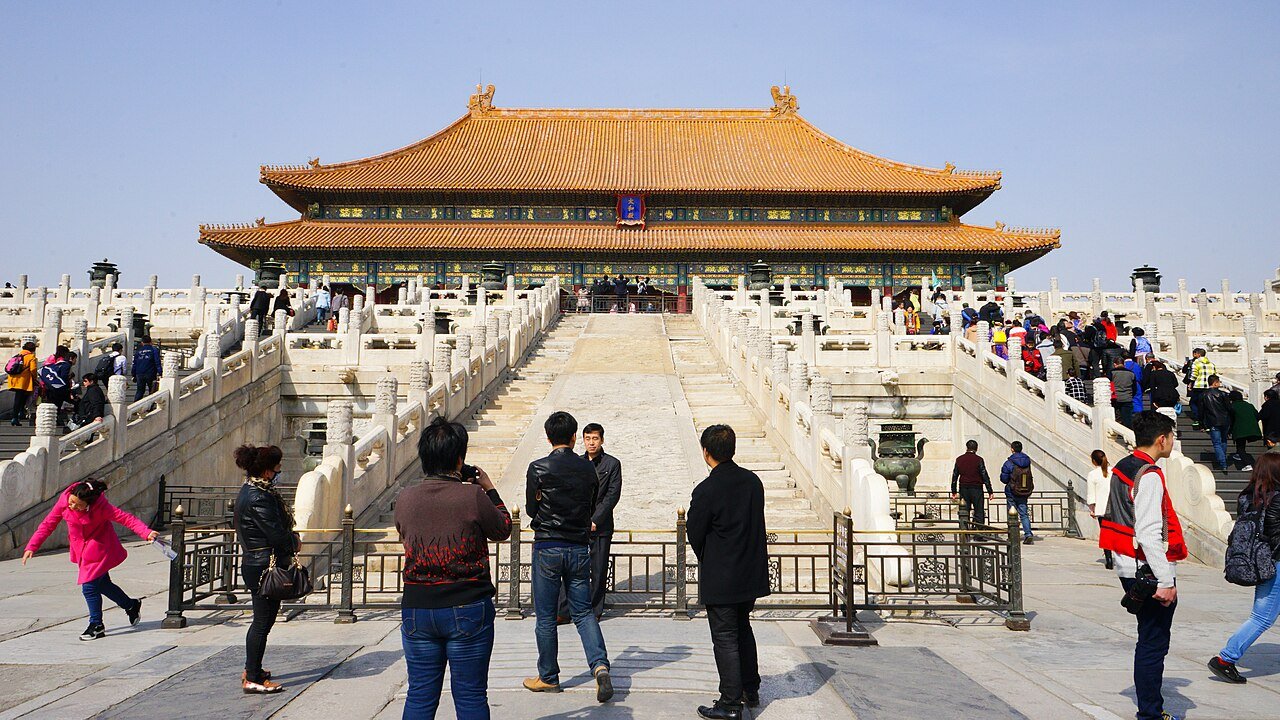
- Be at the Meridian Gate queue by 7:40–8:00. When the gates open at 8:30, clear security and walk quickly up the axis to the Hall of Supreme Harmony — don't stop where the first selfie crowds stop.
- Between 8:30 and 9:30 the great courtyard is empty enough to hear your own footsteps: white marble terraces, and you, and six hundred years of roof ridge. After ten o'clock the tour groups arrive, and the same paving stones become a different palace altogether.
- Groups mass on the central and eastern routes, so walk west against the flow — the western palaces and the Hall of Mental Cultivation first, then loop back to the axis. It feels like having a half-empty Forbidden City to yourself.
- After 15:00 comes the second golden window: long shadows across the ridges, groups draining away, and the best light of the day on the three great halls.
3. Hire the storyteller 请一位讲解员
The worst way to see the Forbidden City for the first time is to look at buildings without hearing the stories. Across 720,000 square metres, without narration, it is rows of empty rooms and a throne you can't approach — and six hundred years are all in the details.
Three options, by budget:
- Official audio guide: rented inside the Meridian Gate, English available, a few tens of yuan plus deposit. Follows your feet.
- Official guide: book at the guide desk on the west side inside the Meridian Gate; Chinese and English, priced by group or duration, and you can ask questions.
- Private guide: the most expensive (hundreds to over a thousand yuan a day), but customisable to your interests — architecture, porcelain, court life, photo spots — and they steer you around the crowds. Time is money, too.
A good guide will tell you, standing in one courtyard, three things you'd never guess: that the floor tiles came from Suzhou; that these roof figures are chi shou, and the Hall of Supreme Harmony has the only set of ten in all of China; and that the plaza has no trees, and it isn't because someone forgot to plant them. After that, the courtyards are no longer empty.
4. Walking the axis 沿着中轴线
Meridian Gate → Gate of Supreme Harmony → the three great halls
- Meridian Gate: five archways, a gate tower with wings like a phoenix. The opera line about being "beheaded outside the Meridian Gate" is theatre — Ming executions happened at the Western Market. The gate's real jobs were ceremony before morning audiences, ritual floggings of defeated generals, and today's blockbuster exhibitions.
- The five inner Golden Water bridges: only the emperor used the central one.
- Hall of Supreme Harmony: China's largest surviving timber building — eleven bays wide, about 2,377 square metres of floor, 35.05 metres tall, and wearing the double-eaved hip roof reserved for the highest occasions. Enthronements, imperial weddings, and New Year audiences happened here. Look up at the ridge: dragon, phoenix, lion, heavenly horse, sea horse, suanni, yayu, xiezhi, douniu, and hangshi — ten figures, the only such set in the country.
- A thousand dragons spitting water: the three-tiered terrace carries more than a thousand carved dragon heads; in heavy rain they pour in tiers, and the harder it rains the better the show.
- Water vats: those gilded bronze "seas" in front of the halls are fire insurance. The gouges on the vats by the Hall of Supreme Harmony are where the Eight-Power Allied Forces scraped the gold off in 1900.
Hall of Central Harmony, Hall of Preserving Harmony → the inner three palaces → the imperial garden
- Hall of Central Harmony: where the emperor rested before ceremonies and received officials' bows.
- Hall of Preserving Harmony: the exam hall for the highest level of the imperial civil service examination. Don't miss the enormous carved cloud-dragon ramp behind it.
- Palace of Heavenly Purity: the emperor's bedroom and office; the secret succession edict was hidden behind the "Justice and Honour" plaque.
- Hall of Union: home of the twenty-five imperial seals.
- Palace of Earthly Tranquillity: the empress's palace, later used for Manchu shamanic ritual and as the imperial wedding chamber — the eastern room still holds the wedding décor of the Kangxi, Tongzhi and Guangxu emperors.
- Imperial Garden: Ming cypresses, twin-trunked trees, and the pavilion on top of the rockery. Reach here and the axis is done, roughly two hours in.
5. Don't stop at the axis — the wings are alive 两翼才是活的故宫
The axis is the skeleton; the wings are the flesh. Budget a further half-day.
- West · Hall of Mental Cultivation: where emperors actually worked after Yongzheng. Qianlong's Study of the Three Rarities is only a few square metres, and once held the Three Rarities calligraphy.
- West · Cining Palace area: now the sculpture gallery — stone carvings and Buddhist figures from the Northern Wei to the Qing. Quiet, uncrowded, excellent for escaping the tide.
- East · Palace of Prolonged Happiness: the palace's one unfinished building. Late Qing plans for a glass "Crystal Palace" with fish swimming around it never materialised; the iron skeleton stands in a pool, the most photogenic ruin in the complex.
- East · Palace of Tranquil Longevity (with the CNY 10 Treasure Gallery ticket): Qianlong's retirement palace, with the Nine Dragon Screen (one of only three in China), the three-storey Changyin Pavilion opera house, and the Well of the Pearl Concubine.
- Gallery of Clocks (Hall for Ancestral Worship, CNY 10): Qing emperors' European timepieces — ones that write, ones that play, ones with walking figures. The most steampunk corner of the palace.
- Hall of Literary Glory and Hall of Martial Valour: rotating exhibitions of ceramics and painting. Check "What's On" before you go.
6. Ten details only a guide tells you 十个细节
- Why the great plaza has no trees: fire prevention, no hiding places for assassins, and a reminder to every visitor of their own smallness.
- Door nails: nine rows of nine, eighty-one per door. Nine is the ultimate yang number — an imperial number.
- "Gold bricks" are not gold: the floors are Suzhou kiln bricks, over a year of work from clay pit to kiln, and they ring when tapped.
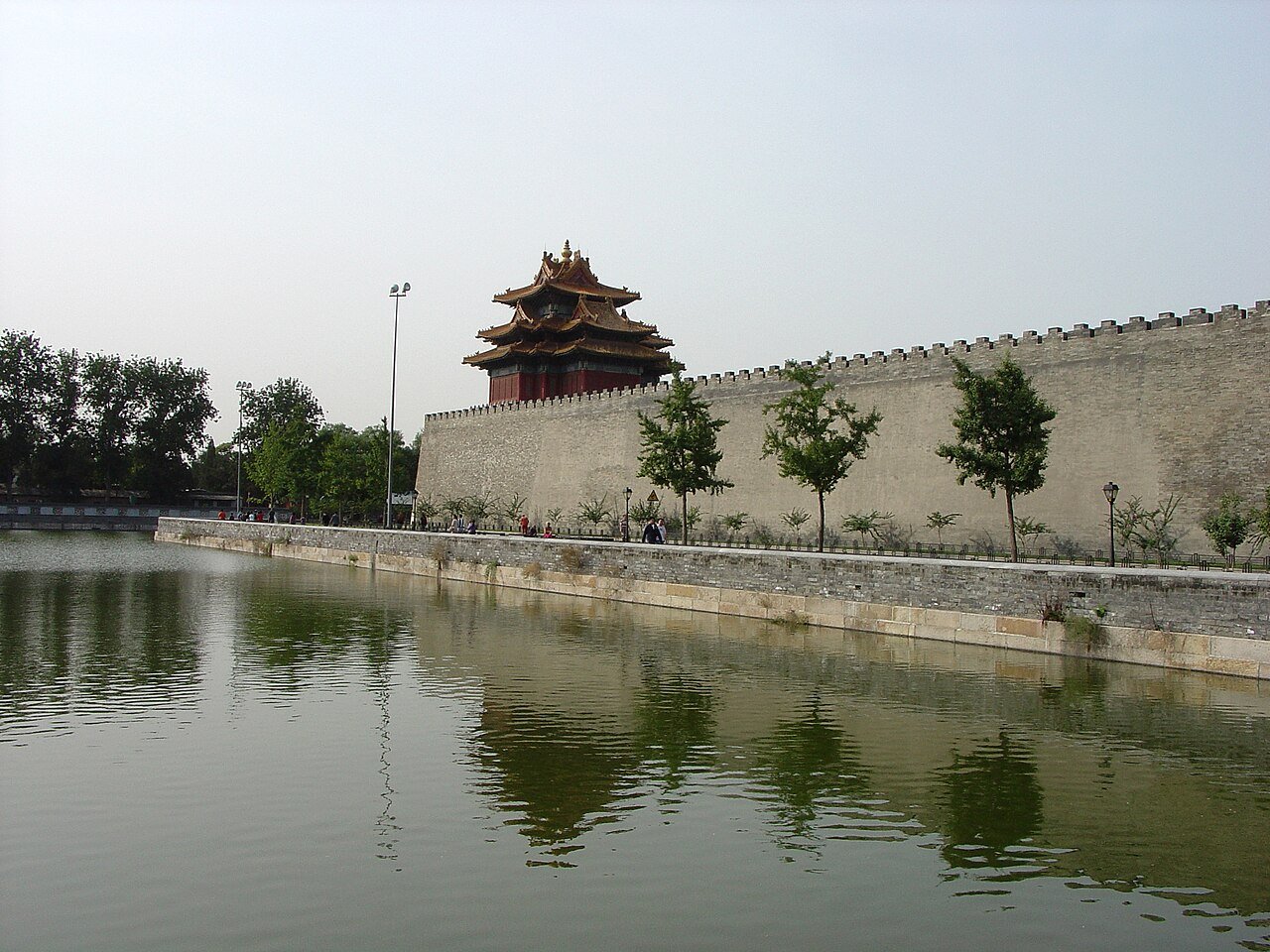
- The corner towers: legend says they have nine beams, eighteen pillars and seventy-two ridges, and that Lu Ban himself appeared to help build them.
- Emperors didn't "hold court" daily: Ming emperors heard reports at the gate; Qing emperors mostly read memorials in the Hall of Mental Cultivation. The grand audience was ceremony more than administration.
- A city of ten thousand: at its height the palace housed emperors, consorts, eunuchs and maids by the thousand, with its own wells, storehouses, workshops, theatres and pharmacy — all behind gate passes.
- The 1933 evacuation: to save them from war, more than 13,000 crates of treasures left the palace, travelled through a dozen provinces over a decade, and arrived almost intact — China's "cultural long march".
- The palace has a hospital: the conservation department is literally a hospital for objects, made famous by the documentary Masters in the Forbidden City. With luck you'll watch a restorer working on a clock through the glass.
- Forbidden City ≠ Palace Museum: from 1420 to 1912 it was the imperial palace, the Forbidden City. Since 10 October 1925 it has been a museum. The names describe a place and an institution.
- One small object is worth the trip: Along the River During the Qingming Festival, A Thousand Li of Rivers and Mountains, the Pingfu Letter, the Five Oxen — all here. Paintings rotate off display quickly for conservation, so catching one is luck; the museum announces the schedule.
7. When to come, how to dodge the crowds 何时来
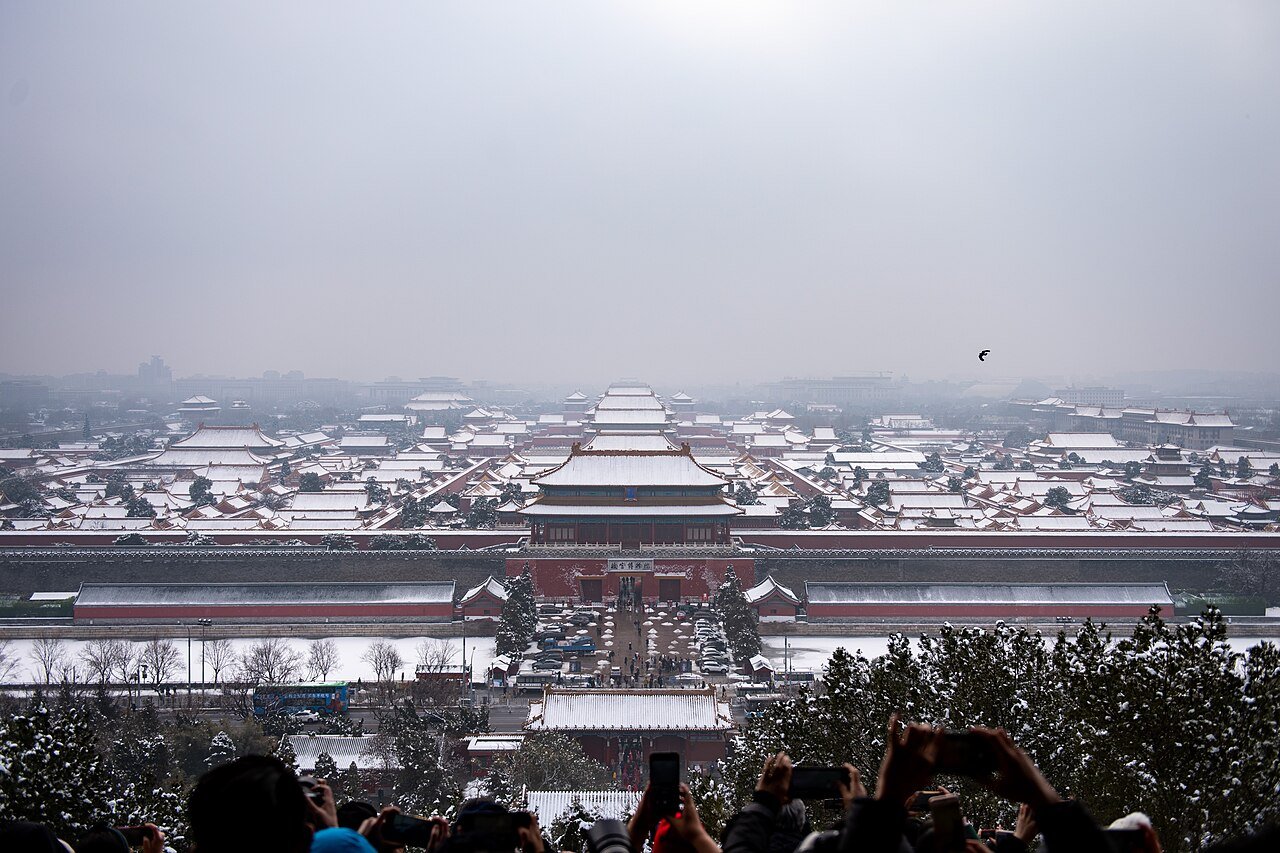
- Season: magnolias and crab apple in April along the Hall of Literary Glory; the two best weeks of the year are late October to mid-November, when the ginkgos turn gold. Snow days are the most beautiful of all — and the hardest ticket.
- Day of week: Tuesday to Thursday are calmest; Friday afternoon builds; weekends and the May/October holidays approach full capacity.
- Time of day: the first hour after opening and the last two hours before closing are two different palaces.
- Stamina: about 2 hours on the axis, 3–4 with the wings, and 8+ kilometres if you do the whole complex. Shoes matter more than cameras.
8. Three routes you can copy 三条路线
- Two-hour essentials: Meridian Gate → Hall of Supreme Harmony → Hall of Central Harmony → Hall of Preserving Harmony → Palace of Heavenly Purity → Palace of Earthly Tranquillity → Imperial Garden → exit at the Gate of Divine Prowess.
- Half day (best value): all of the above plus the eastern Palace of Tranquil Longevity (Nine Dragon Screen, Changyin Pavilion, Pearl Concubine's Well) and the Gallery of Clocks. Lunch at the Ice House restaurant by Cining Palace, exit north, then walk ten minutes up Jingshan and look down on the whole golden sea from Wanchun Pavilion (CNY 2).
- Full day (families, enthusiasts): axis + western six palaces (Hall of Mental Cultivation, Palace of Gathered Elegance) + eastern six palaces (Palace of Prolonged Happiness) + the exhibitions at the Halls of Literary Glory and Martial Valour + both the Clock and Treasure galleries. Afterwards, give the evening to Beihai Park or Wangfujing.
9. Practical notes 给外国朋友的清单
- Passport: the same one for booking and for entry. A photocopy won't scan.
- Payment: WeChat Pay and Alipay now link directly to Visa/Mastercard, which covers tickets and food; keep a little cash anyway.
- Luggage and access: left luggage at the Meridian and Divine Prowess gates; free wheelchairs and strollers. Drones and lighters are prohibited, large tripods are restricted, and selfie sticks are unwelcome in most halls.
- Etiquette: don't touch objects or railings, don't cross barriers, no flash in painting galleries, and don't climb the lions, cranes or balustrades. These rules are enforced, and "walking through the Forbidden City's gate" is a lifetime wish for many Chinese visitors — don't be the one who gets told off.
- Water and toilets: both are plentiful and signposted bilingually; carry an empty bottle.
- Language: the official audio guide has English. If you hire a Chinese-speaking guide, write down your three questions in advance ("which emperor lived here?", "where did this stone come from?", "why are the roofs yellow?"). Guides are at their best answering specifics.
- One phrase to remember: Hall of Supreme Harmony — 太和殿. It's the centre of the city and the first thing everyone wants to see.
- Last word: hours, prices and booking rules above follow the Palace Museum's official notices as of September 2026. Re-check the official site the week you travel.
When you walk out through the Gate of Divine Prowess, turn around once. The roof figures line up in the last of the light, and the moat writes the whole wall upside down. The secret of the Forbidden City isn't how far you walk — it's when you go in, who is talking in your ear, and whether you stood still for a minute in an empty courtyard.
Six hundred years isn't long, as long as somebody speaks for it.
Photos: Forbidden City panorama, Hall of Supreme Harmony, corner tower and moat, snow over the palace — via Wikimedia Commons, CC-licensed; authors and licences on the original file pages. Hours, prices and booking rules checked against the Palace Museum's official site and ticket notices (September 2026). Written by the China Cultured editorial desk.